
Fertiliser Types Explained: Urea, DAP, NPK, Water-Soluble and Micronutrients
Types of Fertilisers: Urea, DAP, NPK, Water-Soluble and Micronutrients
Choosing a fertilizer is not simply a matter of buying the most familiar bag or selecting the product with the highest nutrient number. Urea, DAP, NPK fertilisers, water-soluble fertilisers and micronutrient products perform different functions. The right choice depends on what the soil can already supply, what the crop needs, its growth stage, the irrigation system and the intended application method.
No fertilizer is universally “best”. Urea may correct a nitrogen requirement, but it cannot supply phosphorus or potassium. DAP supplies nitrogen and phosphate, but no potassium. An NPK formulation supplies all three primary nutrients, although its ratio may not suit every crop stage. Water-soluble products enable feeding through irrigation or foliar programmes, while micronutrients address essential trace-element needs.
This guide explains the main types of fertilizers used in agriculture, how their labels should be read and how to select them responsibly.
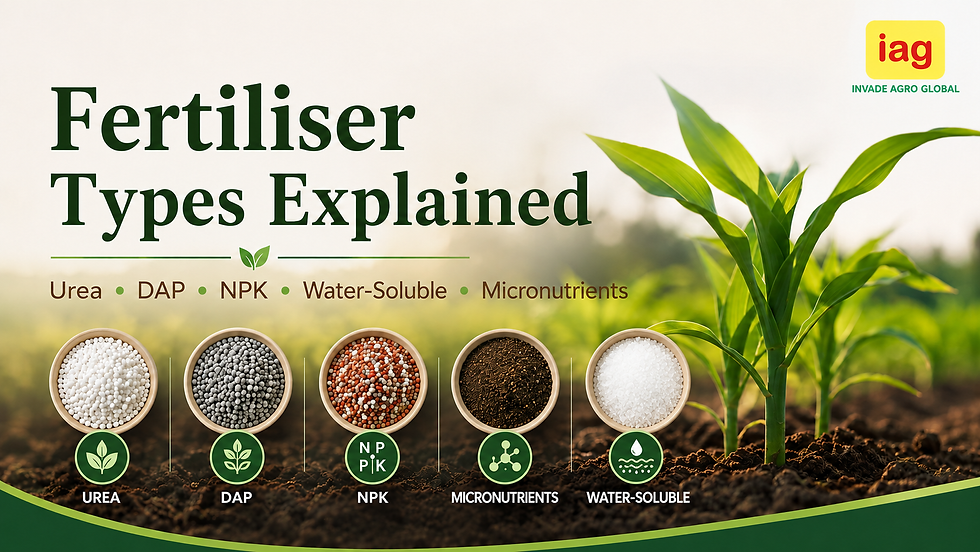
What Are the Main Types of Fertilisers Used in Agriculture?
Five widely used categories are:
Urea: a concentrated nitrogen fertiliser, commonly labelled 46-0-0.
DAP: diammonium phosphate, an NP fertiliser commonly labelled 18-46-0.
NPK fertilisers: products supplying nitrogen, phosphate and potash in defined proportions.
Water-soluble fertilisers: formulations that dissolve in water for fertigation or approved foliar use.
Micronutrient fertilisers: products supplying elements such as zinc, iron, boron, manganese, copper and molybdenum.
The three numbers on a fertiliser label represent the percentages by weight of nitrogen, phosphate expressed as P₂O₅ and potash expressed as K₂O. A 19-19-19 grade therefore contains 19% of each declared primary nutrient form. University of Minnesota Extension explains this guaranteed-analysis convention.
What Is Urea Fertiliser?
Urea is a concentrated nitrogen fertilizer containing approximately 46% nitrogen, which is why it is labelled 46-0-0. Nitrogen contributes to chlorophyll, proteins, enzymes and vegetative development. Crops with insufficient available nitrogen may show weak growth and general yellowing, although appearance alone should not be treated as a diagnosis.
Urea is commonly used in basal programmes or as a top dressing, often through split applications that align nitrogen supply more closely with crop demand.
Management matters because surface-applied urea can lose nitrogen through ammonia volatilisation, particularly when it is not incorporated or moved into the soil by suitable rainfall or irrigation. Soil pH, temperature, moisture, crop residue and application timing all influence this risk. University of Minnesota Extension’s urea guidance explains both urea’s concentration and the factors affecting nitrogen loss.
Urea supplies nitrogen, not balanced crop nutrition. It cannot correct phosphorus, potassium, sulphur or micronutrient deficiencies, while excessive or poorly timed use can reduce nutrient-use efficiency.
What Is DAP Fertiliser?
Diammonium phosphate, or DAP, supplies nitrogen and phosphate. It is commonly sold as 18-46-0, meaning it contains 18% nitrogen and 46% phosphate expressed as P₂O₅. It is therefore an NP fertiliser, not a complete NPK fertiliser.
Phosphorus supports energy transfer, root development, crop establishment and reproductive processes. Because phosphorus moves relatively slowly in many soils, DAP is often associated with basal or planting-time application where soil testing and local recommendations indicate a phosphorus requirement.
DAP should not, however, be treated as a universal sowing input. Soil phosphorus status, pH, crop sensitivity and fertiliser placement all matter. Concentrated ammonium phosphate can injure germinating seed if unsuitable quantities are placed too close, so local placement guidance and product-label directions should always be followed. Penn State Extension specifically recommends caution when placing DAP or urea-containing materials near seed.
DAP supplies no potassium, so repeated use without wider nutrient planning can leave other crop requirements unmet.
What Is NPK Fertiliser?
NPK fertiliser supplies the three primary nutrients required in large quantities by most crops:
Nitrogen (N): supports chlorophyll, proteins and vegetative growth.
Phosphorus (P): supports energy transfer, root growth and reproductive development.
Potassium (K): contributes to water regulation, enzyme activity, stress response and crop quality.
FAO classifies nitrogen, phosphorus and potassium as primary nutrients because plants generally require them in comparatively large quantities.
An NPK label such as 15-15-15 or 12-32-16 describes nutrient concentration, not the required application rate. A 15-15-15 grade contains equal declared percentages of N, P₂O₅ and K₂O, while 12-32-16 is proportionally richer in phosphate.
NPK products may be manufactured as compound or complex fertilisers, physical blends, granular formulations or water-soluble grades.
“Balanced NPK” does not always mean equal numbers. Crop stages may require different proportions, while soil reserves change what must be supplied. A formulation suitable during early establishment may not be appropriate during flowering, fruit development or grain filling.
For a deeper explanation of nutrient ratios and formulations, read Invade Agro Global’s NPK Fertilizer Guide.
What Are Water-Soluble Fertilisers?
Water-soluble fertilisers are designed to dissolve in water and deliver nutrients through an irrigation system or approved foliar application. They may supply NPK, calcium, magnesium, sulphur or micronutrients in different combinations.
Their main advantage is control. Fertigation, the injection of fertilizer into irrigation water can deliver smaller, more frequent doses near the active root zone, especially in horticulture and protected cultivation.
Water-soluble does not mean automatically superior. Products used through drip systems must dissolve sufficiently and remain chemically compatible to reduce precipitation, sediment formation and emitter clogging.
Water temperature, pH, bicarbonates, calcium levels and mixing order can all affect the fertiliser solution. FAO’s fertigation guidance identifies solubility, acidity, compatibility and water analysis as important selection factors.
Granular products may suit soil application, while solution-grade products suit controlled delivery through water. The right choice depends on the crop and production system rather than marketing terminology.
What Are Micronutrient Fertilisers?
Micronutrients are essential plant nutrients needed in much smaller amounts than nitrogen, phosphorus and potassium. They include zinc, iron, manganese, boron, copper, molybdenum, chlorine and nickel.
A shortage of one essential micronutrient can restrict crop performance even when NPK supply appears adequate. FAO identifies iron, zinc, manganese, copper, boron, molybdenum and chlorine as plant micronutrients or trace elements.
Micronutrient products may be supplied as sulphates, oxides, chelates or mixtures. Their performance depends on the crop, soil pH, formulation and application route.
A pale, yellow or distorted leaf does not automatically prove a micronutrient deficiency. Similar symptoms can result from root damage, salinity, water stress, disease, soil compaction or macronutrient imbalance. Soil testing and, where appropriate, plant-tissue analysis provide a stronger basis for diagnosis.
Read Invade Agro Global’s guide to soil testing for crop nutrition and soil health to understand how testing supports more precise fertiliser decisions.
Micronutrients can also be harmful in excess. They should supplement a balanced nutrition programme, not replace NPK fertilisers.
Urea vs DAP vs NPK vs Water-Soluble vs Micronutrients
Each fertiliszer type supplies a different combination of nutrients and serves a distinct role in crop nutrition, application and growth-stage management.
Fertiliser types | Main nutrients | Typical role | Common application | Main limitation |
Urea | Nitrogen | Meeting nitrogen demand | Soil application or top dressing | No phosphorus or potassium |
DAP | Nitrogen and phosphate | Supplying phosphorus with some nitrogen | Basal or placed soil application | No potassium |
NPK | Nitrogen, phosphate and potash | Supplying several primary nutrients | Soil or specialty application, depending on grade | Ratio may not match actual need |
Water-soluble | Soluble macro-, secondary or micronutrients | Controlled feeding through water | Fertigation or approved foliar use | Compatibility and water quality matter |
Micronutrients | Trace nutrients such as Zn, B, Fe and Mn | Correcting specific shortages | Soil, foliar, seed or fertigation use | Cannot replace NPK |
This comparison is a starting point; performance varies by field and production system.
The better question is not, “Which fertilizer is strongest?” It is:
Which nutrient is required, in what quantity, at which crop stage and through which application method?
How to Choose the Right Fertiliser
Choosing among the different types of fertilizers requires matching the crop’s nutrient needs with soil conditions, growth stage and application method.

1. Begin With Soil Testing
A representative soil test can reveal pH, salinity, organic carbon and available nutrient levels, helping distinguish a true nutrient shortage from poor nutrient availability.
Invade Agro Global’s guide to choosing agro inputs for crop, soil and season explains why input decisions should begin with actual field conditions.
2. Define the Crop and Production Target
Crops remove nutrients in different quantities and at different times. Variety, expected yield, previous crop, residue management and irrigation availability also influence the fertiliser programme.
3. Match Nutrition to the Crop Stage
Establishment, vegetative growth, flowering, fruit set and grain filling are not nutritionally identical.
Invade Agro Global’s seasonal crop-planning guide explains how soil conditions, crop stage, climate and expected yield can be connected within a more structured input plan.
4. Select the Application Route
Choose among basal placement, broadcasting, top dressing, banding, fertigation or foliar application according to the crop, equipment and product label.
A grade developed for soil application may not be sufficiently soluble or compatible for injection through drip lines.
5. Check Quality and Compatibility
Verify the fertiliser grade, nutrient source, solubility, product registration, batch information and label instructions. Confirm chemical compatibility before tank mixing or preparing concentrated stock solutions.
6. Follow Local Recommendations
Fertiliser rates should not be copied from one farm, crop or country to another. Soil type, irrigation, rainfall, regulation and yield targets vary.
Use an agronomist, an accredited laboratory and locally approved crop recommendations when developing a fertiliser schedule.
Common Fertiliser Selection Mistakes
Frequent mistakes include choosing a product by bag price rather than cost per unit of nutrient, using urea to address every yellowing symptom, applying DAP without checking soil phosphorus and assuming every NPK ratio is interchangeable.
Another common error is treating foliar nutrition as a complete replacement for root-zone feeding. Foliar products can support specific nutrient requirements, but their role depends on the crop, nutrient, formulation and label.
Other avoidable mistakes include:
Mixing incompatible water-soluble products
Ignoring irrigation-water quality
Applying fertiliser immediately before unsuitable weather
Using an unverified or poorly labelled product
Repeating last season’s schedule without testing
Failing to record application dates, grades and rates
Good crop nutrition is a monitored process: apply, observe, document and adjust using evidence.
Building a Balanced Crop-Nutrition Programme
A balanced programme may combine soil-applied macronutrients, stage-specific NPK grades, water-soluble products, secondary nutrients, micronutrient correction, organic matter management and irrigation planning.
The objective is not to use every category. It is to supply the required nutrients efficiently while protecting soil condition, water quality and farm economics.
Invade Agro Global’s agri-input portfolio connects crop nutrition and micronutrients with seeds, biostimulants, soil enhancers, crop protection and agronomy support. This integrated approach moves fertiliser decisions beyond product habit towards crop-, soil- and region-specific planning.
Conclusion
Urea, DAP, NPK, water-soluble fertilisers and micronutrient products serve different crop-nutrition needs. Urea is a concentrated nitrogen source; DAP supplies nitrogen and phosphate; NPK grades provide all three primary nutrients; water-soluble products enable solution-based feeding; and micronutrients address essential trace-element requirements.
Understanding the main types of fertilizers helps growers choose nutrient sources based on crop and soil requirements rather than product familiarity alone. Matching the nutrient source, formulation, crop stage and application method can improve nutrient-use efficiency, control avoidable costs and reduce the risk of imbalance.
To discuss a crop- and market-specific nutrition programme, connect with Invade Agro Global.
Frequently Asked Questions
What Is the Difference Between Urea, DAP and NPK?
Urea is primarily a nitrogen fertilizer, usually labelled 46-0-0. DAP supplies nitrogen and phosphate, commonly as 18-46-0. NPK fertilisers supply nitrogen, phosphate and potash in ratios such as 15-15-15. Their suitability depends on soil status, crop stage and nutrient demand.
Is DAP an NPK Fertiliser?
No. DAP is an NP fertiliser because it supplies nitrogen and phosphate but no potassium. It can form part of a wider NPK programme, but it is not a complete NPK product by itself.
Are Water-Soluble Fertilisers Better Than Granular Fertilisers?
Not universally. Water-soluble products suit fertigation and approved foliar programmes where solution-based delivery is required. Granular products may be more appropriate for basal or soil application. The right form depends on the crop, irrigation system, water quality and application objective.
Can Micronutrients Replace NPK Fertiliser?
No. Micronutrients perform essential physiological functions but cannot replace nitrogen, phosphorus and potassium. Crops may require both macronutrients and specific micronutrients within a balanced, evidence-based nutrition programme.
Why Is Soil Testing Important Before Fertiliser Application?
Soil testing measures nutrient status, pH and other conditions affecting nutrient availability. It helps avoid unnecessary application and provides a stronger basis for selecting fertiliser type and rate than visual symptoms or previous practice alone.


Comments