
Fruit Tree Spray Schedule: Practical Farmer Guide
Fruit Tree Spray Schedule: What a Good Spray Plan Looks Like in Practice
If you grow fruit trees, you know this: spraying is easy, but spraying correctly is an art. Even the best product can fail if timing, crop stage, or weather is wrong. That is why a fruit tree spray schedule should never be treated as a blind calendar. It should work like a field decision system.
This fruit tree spray guide explains what a practical plan looks like in real orchard conditions. The goal is not to spray more. The goal is to spray at the right time, for the right reason, with safety discipline. As the old saying goes, “A stitch in time saves nine.” In orchards, timely protection can save quality and cost.

What Is a Good Spray Plan?
A fruit tree spray schedule is a planned approach to protecting fruit trees from pests, diseases, and quality losses across the season. It connects crop stage, pest pressure, disease pressure, weather, orchard history, and market requirements.
In simple words, it tells you when a spray may be needed, why it is needed, and what should be checked before spraying. A good spray schedule for fruit trees is not copied from last year. It changes with rainfall, humidity, pest movement, flowering behaviour, fruit set, and harvest timing.
A fruit tree spraying schedule that works in one orchard may not work in another because soil, canopy, variety, water source, and pest pressure can differ. So, ask not only “What should I spray?” Ask, “What is happening in my orchard today?”
Why a Fixed Spray Calendar Often Fails
A fixed fruit tree spray calendar looks convenient, but orchards do not follow office calendars. Rain may arrive early. A new flush may come late. Humidity may build disease pressure quickly. A minor pest may become serious this year.
That is why a fruit tree spray schedule should stay flexible. If a farmer sprays without field scouting, the result can be extra cost, poor control, residue risk, or missed timing. If the farmer waits until damage is visible everywhere, control becomes harder and more expensive.
Integrated pest management supports this approach. FAO explains that IPM helps reduce pesticide residues, protect ecosystem services such as pollination, reduce production costs, and support better crop quality when pesticide use is reduced responsibly.
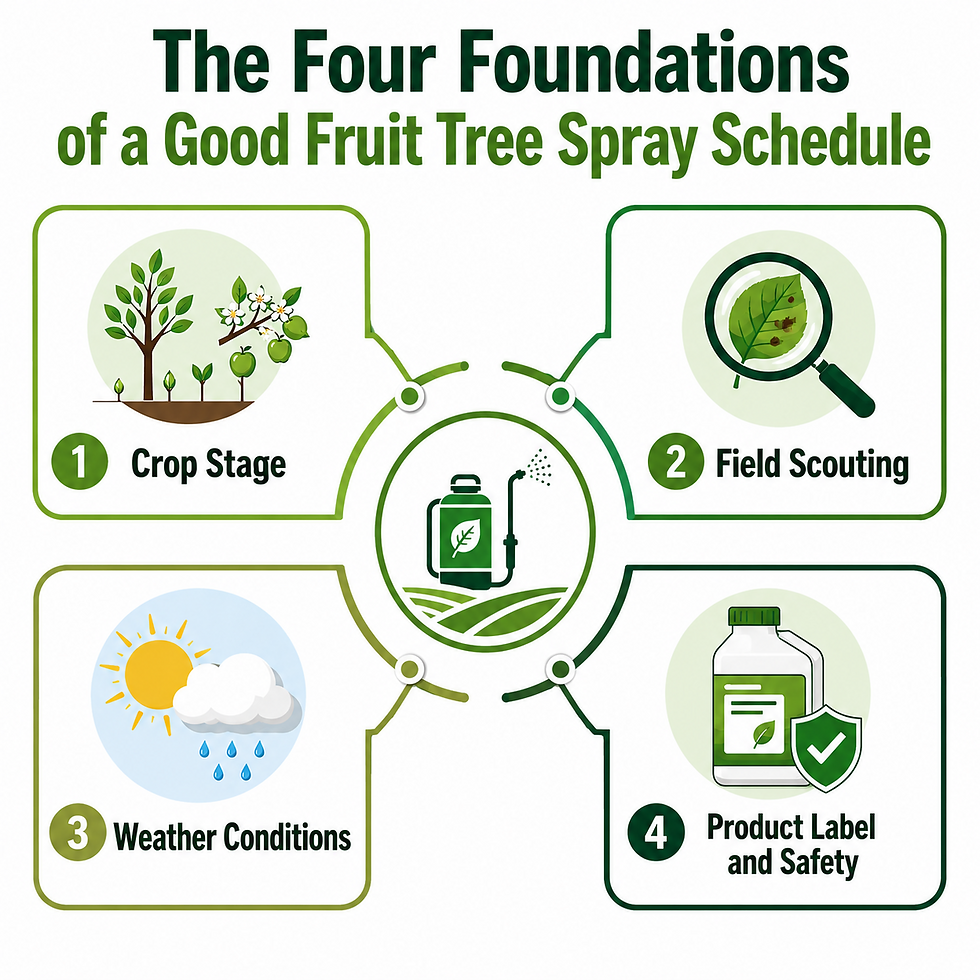
The Four Foundations of a Good Fruit Tree Spray Schedule
1. Crop Stage
Every crop stage has a different risk. Dormant trees may carry pest eggs or disease sources. New flush attracts sucking pests. Flowering is sensitive because pollination is happening. The fruit set needs close attention. During fruit development, fungal diseases, borers, and sucking pests can affect quality. Near harvest, the pre-harvest interval becomes critical.
So, fruit tree spray timing must be connected to the crop stage, not only to dates.
2. Field Scouting
Field scouting is the backbone of a strong spray plan. Walk the orchard. Check leaves, shoots, flowers, fruits, trunk area, and lower canopy. Look for eggs, larvae, honeydew, fungal spots, fruit scars, and leaf curling. Without field scouting, spraying becomes guesswork. With field scouting, you know whether pest pressure is rising, disease pressure is building, and the previous spray worked.
3. Weather Conditions
A spray done in the wrong spray window gives poor results. High wind can cause drift. Rain soon after spraying may reduce effectiveness. Very high temperature can stress the crop or evaporate droplets. High humidity, on the other hand, may favour fungal diseases. Weather-based spray planning matters because canopy density, leaf wetness, and humidity can change disease risk quickly.
4. Product Label and Safety
A practical spray plan must respect the pesticide label. The label tells you the crop, dose, application method, safety precautions, and waiting period. In India, PPQS advises farmers to use clean water, wear protective clothing such as gloves and face masks, read pesticide container labels carefully, and avoid overdose. Farmers should also use only locally approved and registered products.
What a Practical Spray Plan Looks Like by Growth Stage
A practical fruit tree spray schedule by growth stage gives farmers a clear way to think. This fruit tree spray schedule keeps decisions stage-wise, not random. It does not replace local agronomy advice, but it helps structure decisions.
Crop Stage | Main Risk | Spray Planning Focus |
Dormant / after pruning | Carryover pests and diseases | Orchard sanitation and preventive planning |
New flush | Sucking pests, early infection | Scout tender leaves and shoots |
Pre-flowering | Pest and disease build-up | Protect flowering potential |
Flowering | Pollination sensitivity | Avoid unnecessary sprays |
Fruit set | Fruit damage and early infection | Monitor young fruits closely |
Fruit development | Fungal disease, borers, sucking pests | Rotate product groups responsibly |
Pre-harvest | Residue risk | Follow PHI and market requirements |
Post-harvest | Carryover risk | Clean orchard and plan recovery |
This fruit tree spray guide shifts attention from “spray date” to “crop need.” For example, a fruit tree spray schedule before flowering should focus on protecting the tree’s flowering potential. A fruit tree spray schedule after the fruit set should focus more on young fruit protection, disease prevention, and residue-aware planning.
Sample Spray Record Format Farmers Can Use
A spray plan becomes stronger when it is written down. Memory is useful, but records are more reliable.

This simple orchard spray schedule helps farmers compare what was planned, sprayed, and achieved. It also supports residue management, input cost control, and team discipline.
The pre-harvest interval, or PHI, is the waiting time between application and harvest. NPIC explains that PHI is stated on the label and helps reduce pesticide residue risk on food crops.
Common Fruit Tree Spray Mistakes Farmers Should Avoid
Spraying Only After Damage Is Visible
One of the biggest fruit tree spray mistakes farmers should avoid is waiting until damage spreads. By then, pests may be inside fruit, flowers may be damaged, or disease may have moved across the canopy. A fruit tree pest control schedule should combine prevention, monitoring, and timely action.
Using the Same Product Repeatedly
Repeating the same product group can increase resistance risk. Resistance management is a practical necessity. Rotation should be guided by product label, pest type, and expert advice.
Ignoring Flowering Stage Sensitivity
Spraying during flowering needs care because pollination is directly linked to the fruit set. Avoid unnecessary sprays and consider pollinator safety and label restrictions.
Poor Spray Coverage
A fruit tree disease control spray may fail if coverage is weak. Check nozzle condition, spray volume, water quality, canopy penetration, and speed. Often, the problem is not only the product; it is how the spray reaches the plant.
Forgetting PHI
Near harvest, safety matters as much as control. Harvesting before the required PHI can create residue risk and market rejection.
How IAG Looks at Fruit Tree Spray Planning
At Invade Agro Global, spray planning is part of a wider crop protection system. IAG’s platform combines agri-inputs, agronomy programs, field intelligence, and crop protection support.
This matters because the plan should connect with agri inputs and crop protection solutions, data-led agronomy advisory, smart crop scouting, and practical farm consulting.
IAG’s Agri Inputs & Innovation includes seeds, fertilizers, biostimulants, pesticides, and advanced crop technologies, while Agri Intelligence & Technology focuses on AI, data analytics, and precision solutions.
In a good fruit orchard spray guide, the aim is simple: reduce waste, improve timing, protect quality, and help farmers decide confidently.
Conclusion
A good fruit tree spray schedule is not about filling the sprayer more often. A responsible fruit tree spray schedule starts with observation. It is about reading the crop, respecting the label, keeping records, and acting before problems become losses.
The best fruit tree spray guide is practical, flexible, and responsible. It protects the crop without ignoring safety, cost, pollination, residue, or market quality. For farmers and orchard managers, this is where better planning becomes better performance.
Need support in building a crop protection plan for your orchard? Connect with IAG’s agronomy and field advisory team.
FAQs
What is a fruit tree spray schedule?
A fruit tree spray schedule is a crop-stage-based plan for managing pests, diseases, and residue risk through safe, need-based spraying.
When should fruit trees be sprayed?
If you are wondering when to spray fruit trees for pests and diseases, the answer depends on crop stage, field scouting, weather, pest pressure, and label guidance.
How often should fruit trees be sprayed?
How often fruit trees should be sprayed depends on the crop, season, disease pressure, pest pressure, product label, and local agronomy advice. Avoid fixed intervals without observation.
Is the same spray plan suitable for all fruit trees?
No. Mango, citrus, apple, grapes, and other fruit crops have different growth stages, pest risks, disease risks, and market needs.
Why is field scouting important before spraying?
Field scouting helps farmers avoid unnecessary sprays, identify problems early, improve spray timing, and make decisions more accurately.


Comments