
Regenerative Agriculture for Soil Health and Farming
Across farms, a quiet shift is happening. Farmers are putting in the same effort, applying similar inputs, and following familiar methods, yet the outcomes are no longer consistent. Yields fluctuate, soil becomes harder, and water does not stay where it should. This is not just a productivity issue; it is a signal that soil health is declining. This is where regenerative agriculture becomes critical.

Unlike conventional systems, regenerative agriculture focuses on rebuilding soil health rather than maintaining declining productivity. It moves beyond traditional sustainable agriculture practices by actively restoring biological activity, improving structure, and increasing long-term resilience.
Research shows that soils managed under regenerative agriculture can increase organic carbon by 0.5% to 2% within 3 to 5 years, significantly improving both fertility and water retention. For farmers, this shift creates a system where soil performance improves over time instead of deteriorating.
What Are the Core Principles and Practices of Regenerative Agriculture?
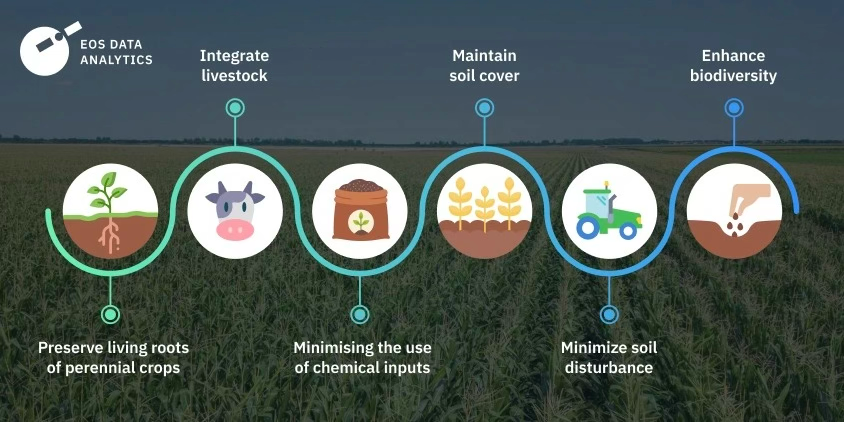
The foundation of regenerative agriculture is built on the understanding that soil is a living ecosystem. Every action taken on the field directly affects its biological activity, structure, and long-term productivity. Reducing soil disturbance is one of the most important starting points. Excessive tillage breaks soil aggregates and releases stored carbon into the atmosphere. By minimizing disturbance, farmers adopt one of the most effective soil regeneration techniques that protects long-term fertility.
Keeping soil covered through crop residues or cover crops helps prevent erosion, regulate temperature, and improve moisture retention. This approach strengthens organic soil management and protects the soil from external stress. Maintaining living roots throughout the year ensures that soil microbes remain active. Continuous biological activity plays a central role in soil health improvement methods, enabling nutrient cycling and supporting plant growth naturally.
Diversity is another critical factor. Crop rotation and mixed cropping systems reduce pest pressure, improve nutrient balance, and align with both regenerative farming practices and sustainable agriculture practices. Livestock integration further enhances this system. Managed grazing allows nutrients to cycle back into the soil, accelerating regeneration and strengthening overall farm productivity. Together, these principles form the backbone of regenerative agriculture, creating a system where soil continuously rebuilds itself.
How Does Regenerative Agriculture Improve Soil Health and Climate Resilience?
The most powerful changes in regenerative agriculture happen below the surface. Soil organic matter plays a key role in this transformation. Even a 1% increase in organic matter allows soil to retain approximately 20,000 to 25,000 gallons more water per acre, which directly improves drought resistance and reduces irrigation dependency.
At the same time, biological activity increases significantly. Microorganisms, fungi, and earthworms thrive under organic soil management, creating a natural system that supports nutrient availability without heavy reliance on synthetic inputs. Water behavior also changes. Farms practicing regenerative agriculture experience better infiltration rates, reduced runoff, and improved moisture retention, which are essential for long-term resilience.
Carbon sequestration is another major advantage. Studies indicate that regenerative agriculture systems can sequester 1 to 3 tons of carbon per hectare annually, making it one of the most effective soil regeneration techniques for addressing climate change. Farms that adopt regenerative farming practices are better equipped to handle extreme weather conditions. Combined with sustainable agriculture practices, this approach reduces emissions and strengthens the entire agricultural ecosystem.
Is Regenerative Agriculture Profitable and How Can Farmers Transition Successfully?
The financial viability of regenerative agriculture is becoming increasingly clear as more farmers adopt these systems. As soil health improves, dependency on fertilizers and pesticides decreases. This can reduce input costs by 20% to 40% over time, depending on the farming system and region. This shift is driven by improved soil health improvement methods and natural nutrient cycling.
Yield stability is another important factor. While the transition phase may require adjustment, farms practicing regenerative agriculture tend to perform more consistently, especially under unpredictable climate conditions. There is also a growing global demand for food produced through regenerative farming practices and sustainable agriculture practices. This demand creates premium pricing opportunities, particularly for export-oriented producers who can demonstrate traceability and responsible production methods.
However, transitioning to regenerative agriculture requires patience and strategic planning. Soil regeneration is a gradual process, and results may take time to become visible. The most effective approach is to start with manageable changes. Farmers can introduce cover crops, reduce tillage, and adopt organic soil management techniques such as composting.
Gradual implementation allows farmers to understand how different soil regeneration techniques perform under their specific conditions. Monitoring progress is equally important. Tracking improvements in soil structure, moisture retention, and biological activity helps refine strategies and ensures long-term success.
What Are the Key Benefits of Regenerative Agriculture for Farmers and the Environment?
The benefits of regenerative agriculture extend across productivity, sustainability, and profitability.
Improves soil fertility through natural processes
Enhances water retention and reduces runoff
Strengthens biodiversity and soil biology
Reduces dependency on chemical inputs
Supports carbon sequestration in soils
Builds resilience against climate variability
Creates premium market opportunities
Improves long-term farm profitability
These outcomes demonstrate that regenerative agriculture is not only an environmental solution but also a practical and scalable business strategy supported by strong regenerative farming practices, soil health improvement methods, and organic soil management.
Conclusion: Regenerative Agriculture Is Redefining the Future of Farming
Agriculture is entering a new phase where the focus is shifting from short-term output to long-term sustainability and resilience. Regenerative agriculture represents this transition. It offers a system where soil health improves over time, input costs decrease, and productivity becomes more stable. By combining sustainable agriculture practices with advanced soil regeneration techniques, farmers can build systems that are both profitable and environmentally responsible.
As global markets evolve and climate pressures increase, the role of regenerative agriculture will continue to expand. Farms that invest in soil health today are likely to be more competitive, resilient, and sustainable in the years ahead. Ultimately, regenerative agriculture is not just a method of farming; it is a shift in mindset. It recognizes soil as a living asset and focuses on restoring its strength so that it can continue to support food production for generations to come.


I trust The Luna Clinic because they are a consultant led fertility treatment clinic in London focused on personalised fertility care. Their experienced team supports me from diagnosis to treatment, helping me feel informed, comfortable, and hopeful throughout my journey. www.lunafertility.co.uk