
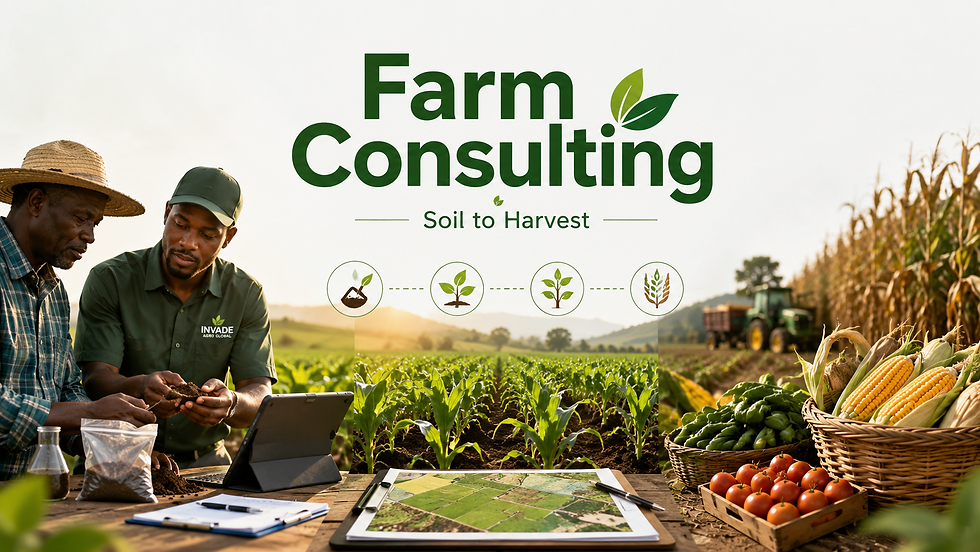
Farm Consulting from Soil Test to Harvest Plan
Farm Consulting from Soil Test to Complete Harvest Planning
Most farmers don't fail at farming. They fail at planning.
A late soil test. The wrong fertilizer at the wrong growth stage. A pest outbreak that could have been caught two weeks earlier. These are not bad luck, they are gaps in a disconnected system.
Farm consulting fixes that.
It is a structured, season-long process that connects soil testing, crop selection, fertilizer planning, irrigation management, pest monitoring, and harvest review into one practical plan. Not generic advice, a real roadmap built around your farm, your soil, and your season.
Today's farmers are asking sharper questions: What does my soil need? Which crop will perform better? How do I grow more without spending more?
A good farm consultant helps you answer every single one.
What Is Farm Consulting?
Farm consulting is a professional advisory service that helps farmers plan, manage, and improve farming operations. It covers soil health, crop planning, input selection, fertilizer dosage, irrigation scheduling, pest and disease management, harvest planning, and farm profitability.
In simple words, farm consulting helps farmers move from guesswork to planned cultivation.
Instead of using the same fertilizer, pesticide, or irrigation method every season, agricultural consulting looks at the actual field condition and gives recommendations based on crop, soil, weather, water availability, pest pressure, and expected market outcome.
This makes farm advisor services useful for small farmers, large farms, FPOs, plantations, agri-input dealers, and agribusinesses.
Why Farm Consulting Starts with Soil Testing
The first step in good farm consulting is understanding the soil. Soil is not just a place where the crop grows. It is the foundation of crop nutrition, root development, water movement, microbial activity, and plant health.
FAO estimates that nearly one-third of the world’s soils are degraded. This is why soil testing should not be treated as an optional step in farm planning. Without soil testing, fertilizer planning often becomes guesswork. A farmer may apply more nitrogen when the actual problem is low organic carbon, poor pH, micronutrient deficiency, salinity, or poor nutrient availability.
That is why soil testing is one of the most important steps in agri consultancy services.
What a Soil Test Usually Checks
A soil test may check several important parameters, such as:
Soil pH
Electrical conductivity
Organic carbon
Nitrogen
Phosphorus
Potassium
Sulphur
Zinc
Boron
Iron
Manganese
Copper
Soil texture
Salinity or alkalinity issues
These results help the consultant understand whether the soil is acidic, alkaline, nutrient-deficient, salt-affected, low in organic matter, or suitable for the planned crop.
How Soil Test Results Are Used in Farm Planning
A soil test report is useful only when it is interpreted properly. Many farmers receive soil test reports but are unsure how to use them in actual farming decisions.
A farm consultant converts the report into a practical crop plan.
For example:
If the soil has low organic carbon, the advisory may include compost, farmyard manure, green manure, crop residue management, or biological inputs.
If the soil pH is too high or too low, the consultant may suggest correction practices before planning fertilizer application.
If phosphorus is already sufficient, the farmer may avoid unnecessary phosphorus application and reduce input waste.
If potassium is low in a fruit crop or vegetable crop, the consultant may plan potassium nutrition at the right crop stage to support fruit quality and yield.
This is where farm consulting becomes practical. It does not stop at the report. It turns the report into action.
What Do Agri Consultancy Services Include?
Agri consultancy services cover the full crop cycle. A good advisory plan does not begin after the crop is already facing stress. It starts before sowing and continues until harvest.

1. Farm Assessment and Field Diagnosis
Before recommending any crop or input, a farm consultant first studies the field.
This may include:
Farm location
Soil type
Water source
Irrigation method
Previous crop history
Existing pest or disease issues
Input usage pattern
Drainage condition
Labour availability
Farmer’s budget
Expected market demand
This field diagnosis helps identify the real reason behind crop performance problems.
For example, low yield may not always be due to poor seed quality. It may be due to wrong sowing time, poor soil preparation, nutrient imbalance, water stress, pest pressure, or delayed crop protection.
Farm consulting helps separate symptoms from root causes.
2. Crop Selection and Season Planning
Choosing the right crop is one of the most important farming decisions. A crop should not be selected only because it gives good returns to someone else. It should match the farmer’s soil, climate, water availability, investment capacity, labour availability, and market access.
Agri consultancy services help farmers decide:
Which crop is suitable for the soil
Which variety or hybrid should be selected
What is the right sowing window
What crop rotation should be followed
Which crop has better local demand
What input cost may be required
What risks may appear during the season
This is especially important for vegetables, fruits, pulses, cereals, oilseeds, plantation crops, and high-value crops where wrong planning can increase cost and reduce profit.
For more clarity on matching inputs with crop, soil, and season, read our guide on choosing the right agro inputs for better farm planning.
3. Soil-Test-Based Fertilizer Planning
One of the biggest benefits of farm consulting is better fertilizer planning.
Many farmers apply fertilizers based on habit, dealer recommendation, neighbour practice, or previous season experience. But every field has a different nutrient condition. Even two farms in the same village may need different fertilizer plans.
A soil-test-based fertilizer plan helps decide:
Which nutrients are deficient
Which nutrients are already sufficient
How much fertilizer is required
When fertilizer should be applied
Whether split application is needed
Which organic inputs can support soil health
Which micronutrients are required
How to avoid overuse or underuse
Balanced fertilizer planning improves nutrient-use efficiency and helps farmers spend more wisely on agri inputs.
4. Crop Nutrition and Agri Input Advisory
Farm consulting also includes crop nutrition planning. Crop nutrition is not only about NPK. Crops need macro, secondary, and micronutrients at different growth stages.
For example:
Early growth needs root development support
Vegetative stage needs balanced nitrogen and other nutrients
Flowering stage needs careful nutrient management
Fruit development stage may need potassium, calcium, boron, and other nutrients depending on the crop
Stress stages may require biostimulants or corrective nutrition
A consultant helps prepare a crop-stage-wise nutrition plan so that inputs are applied at the right time, in the right quantity, and for the right purpose.
This is where agri input advisory becomes very important. The goal is not to use more products. The goal is to use suitable products correctly.
To understand different types of agri inputs and their role in farming, read our complete guide on agri inputs in agriculture.
5. Irrigation and Water Management
Water management is a major part of farm consulting. Even good seed and good fertilizers may not give results if irrigation is poorly managed.
Globally, agriculture accounts for about 69% of water withdrawals. This makes irrigation planning one of the most important parts of farm consulting.
Too little water can create crop stress. Too much water can reduce oxygen in the root zone, increase disease risk, leach nutrients, and damage crop growth.
Agricultural consulting may include:
Irrigation scheduling
Drip irrigation planning
Water quality review
Drainage correction
Moisture monitoring
Crop-stage-wise water requirement planning
Fertigation planning
In crops grown under drip irrigation, water and fertilizer planning are closely connected. A consultant may help farmers schedule fertigation according to crop stage, soil condition, and nutrient requirement.
6. Pest and Disease Monitoring
Farm consulting also covers pest and disease management. However, good consulting does not mean spraying after the problem becomes severe. It means regular monitoring and early action.
FAO states that up to 40% of global crop production is lost every year due to plant pests and diseases. This shows why pest monitoring should not be treated as a last-minute activity. Regular field observation helps farmers identify early warning signs and take timely action before crop damage becomes severe.
A consultant or field advisor may check:
Pest symptoms
Disease symptoms
Leaf colour changes
Root health
Insect population
Weather-related disease risk
Crop stress signs
Weed pressure
This helps farmers make timely decisions. In many cases, early monitoring can reduce unnecessary pesticide use and prevent larger losses.
Good crop protection advisory should include:
Correct pest identification
Correct product selection
Correct dosage
Correct spray timing
Rotation of active ingredients
Safety precautions
Waiting period before harvest
Resistance management
This protects both crop health and farmer profitability.
7. Harvest Planning and Yield Review
Farm consulting does not end when the crop looks ready. Harvest planning is also important.
A harvest plan may include:
Expected harvest window
Crop maturity assessment
Labour planning
Grading and sorting plan
Market timing
Storage or transport planning
Quality checks
Post-harvest loss reduction
Yield estimation
Season performance review
For perishable crops such as fruits and vegetables, harvest timing can directly affect price, quality, shelf life, and buyer acceptance.
After harvest, a consultant may also review the season:
What worked well?
Which inputs gave a good response?
Where did the cost increase?
Which pest or disease caused damage?
Was irrigation properly managed?
Was the yield close to expectation?
What should change next season?
This review helps improve the next crop cycle.
How Farm Consulting Helps Reduce Input Waste
Farm consulting helps reduce input waste by making every input decision more specific.
Instead of applying products without diagnosis, the farmer can apply inputs based on soil condition, crop stage, pest pressure, and expected outcome.
This can help reduce:
Unnecessary fertilizer application
Wrong pesticide usage
Excess irrigation
Repeated spray costs
Nutrient imbalance
Crop stress
Poor crop response
Last-minute correction expenses
The purpose of agri consultancy services is not only to increase production. It is also to improve input efficiency and protect farm profitability. A farmer may not always need more inputs. Sometimes, the farmer needs better timing, better dosage, better product selection, and better planning.
To understand how input decisions affect cultivation cost and farmer profitability, read our blog on agricultural input costs and farm profit.
Farm Consulting vs General Farming Advice
Farmers often receive advice from many sources. Some advice may be helpful, but it may not always be specific to the farmer’s field.
Here is the difference:

This is why farm consulting is more useful when the farmer needs a complete crop plan, not just one-time advice.
When Should Farmers Use Agri Consultancy Services?
Farmers should consider agri consultancy services when:
They are planning a new crop
Soil fertility is declining
Yield is not improving despite high input cost
Pest or disease attacks are repeated
Crop quality is poor
Fertilizer use is high but crop response is low
Water availability is limited
They want to shift to high-value crops
They want better harvest planning
They are managing larger farms or multiple plots
They need crop-stage-wise input planning
Farm consulting is especially useful before the season begins. Early planning gives better control over crop cost, crop health, and harvest outcome.
How Invade Agro Global Looks at Farm Consulting
At Invade Agro Global, farm consulting is closely connected with field intelligence, agri-input access, crop nutrition, crop protection, and advisory-led farming support.
Modern agriculture needs more than product availability. Farmers need the right input, at the right time, with the right technical understanding.
This is why farm consulting must be connected with:
Soil health
Crop nutrition
Genuine agri inputs
Field-level advisory
Crop-stage planning
Sustainable farming practices
Farmer profitability
Harvest outcomes
Invade Agro Global works with a wider agri ecosystem where seeds, fertilizers, biostimulants, crop protection, and precision farming technologies are not treated as separate pieces. They are part of a complete farming system.
A well-planned farm consulting approach helps farmers make confident decisions throughout the crop cycle.
FAQs
What does farm consulting include?
Farm consulting includes soil testing, field diagnosis, crop planning, fertilizer advisory, irrigation management, pest monitoring, harvest planning, and profitability review.
What are agri consultancy services?
Agri consultancy services help farmers plan and manage crops using soil data, field observations, crop-stage needs, and input planning.
Why is soil testing important in farm consulting?
Soil testing helps identify nutrient levels, pH, organic carbon, and soil health, allowing better fertilizer and crop nutrition planning.
How does farm consulting help reduce costs?
Agricultural consulting reduces costs by avoiding unnecessary fertilizers, wrong pesticide use, excess irrigation, and unplanned input spending.
What is the difference between farm consulting and agri input selling?
Agri input selling focuses on products. Farm consulting focuses on diagnosis, planning, correct input use, timing, and better crop outcomes.


vhai aplog reality me kuch karte hai, or AI se photo aur content nikalke paste marte hai?